California has crossed an important threshold in its effort to reduce wildfire losses.
On August 19, 2026, the California Board of Forestry and Fire Protection approved the final draft of the state’s new Zone 0 defensible-space regulations, establishing California’s first statewide standards focused specifically on the first five feet surrounding homes and other occupied structures in designated wildfire-hazard areas. The regulations were developed pursuant to AB 3074 and subsequent legislation and executive action following years of wildfire losses and, more recently, the catastrophic January 2025 fires in Los Angeles County.
The Board describes the policy as a phased, practical approach focused on reducing the ability of wind-driven embers, flames and heat to ignite materials immediately adjacent to buildings. For new construction, the requirements will apply upon the regulation becoming effective. Existing homes will have substantially more time, with implementation occurring in phases over as much as five years.
That distinction is important.
For homeowners in Los Angeles, Zone 0 does not mean that everyone must immediately remove landscaping within five feet of a house. It does mean that California has established a new framework that will increasingly shape how residents, local fire departments, insurers, landscapers, community organizations and local governments think about the area immediately surrounding a structure.
And in Southern California, that conversation is far from over.
What the Board Approved
The adopted framework applies to structures in State Responsibility Areas and to structures located in Very High Fire Hazard Severity Zones within Local Responsibility Areas. Those hazard maps are created by CAL FIRE’s Office of the State Fire Marshal based on physical fire-hazard conditions such as fuels, terrain, expected flame length, ember exposure and fire weather. Importantly, the maps describe hazard, not the individual risk of a particular home. They do not account for whether a homeowner has hardened a structure, reduced fuels or otherwise mitigated the property.
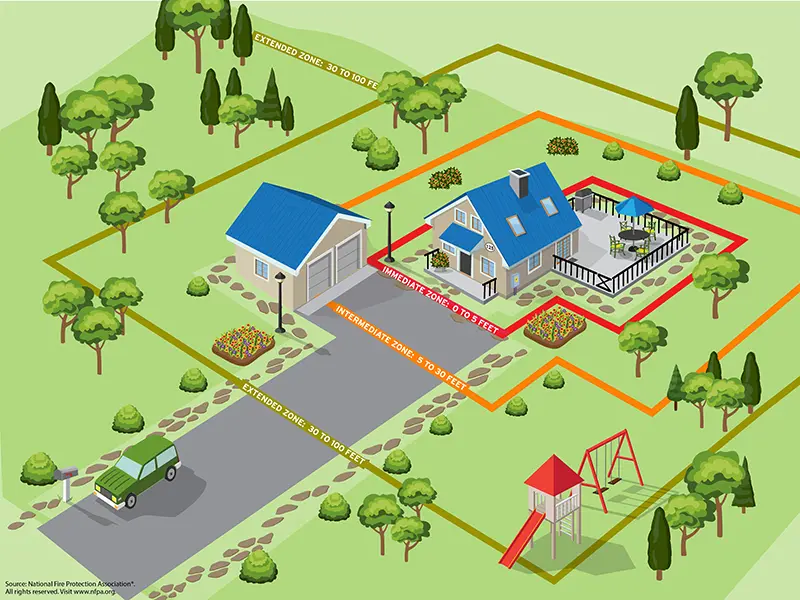
The final Zone 0 framework creates two basic areas within the first five feet surrounding a home.
Immediately adjacent to the structure—and beneath eaves—is a noncombustible safety area intended to protect particularly vulnerable portions of the building. Additional clearance is required around windows, doors, vents and attached decks or similar features.
Outside those immediate buffers but still within the five-foot Zone 0 area, certain maintained vegetation is permitted. The final regulation allows specified herbaceous plants, low groundcovers, maintained grass, certain potted plants in noncombustible containers and existing trees when those trees meet maintenance and clearance requirements.
The rules also address combustible mulch, wood chips, firewood, fencing, gates, sheds, tree limbs, ladder fuels, roofs and gutters.
For existing homes, implementation is phased. During the first three years, homeowners are expected to address measures such as combustible materials, dead vegetation, mulch and wood chips, firewood, roof and gutter debris, and specified tree-maintenance requirements. A second phase, completed on a locally determined schedule within five years, addresses additional safety-zone requirements, combustible gates, fencing and certain outbuildings.
The Board has repeatedly emphasized that implementation is intended to begin with education, outreach and measurable progress, rather than immediate punitive enforcement.
That should provide some reassurance to homeowners who are hearing about Zone 0 for the first time.
There is time to understand what the rules mean.
There is time for Los Angeles jurisdictions to determine how they will implement them.
And there is time for homeowners to make thoughtful decisions rather than reacting by removing mature landscaping unnecessarily.
Why Southern California Is Different
The central challenge is that California’s wildfire environments are extraordinarily diverse.
A five-foot area surrounding a home in a forested community on a large parcel may bear little resemblance to the same five-foot area in Brentwood, Pacific Palisades, Bel Air, the Hollywood Hills, Glendale, La Cañada Flintridge or another densely developed Southern California hillside neighborhood.
Homes in many Los Angeles communities may be only several feet apart. Side yards can be narrow. Accessory dwelling units may sit close to adjoining parcels. Hillsides can be steep. Mature vegetation may provide shade, privacy, erosion control and substantial neighborhood value. Many structures were built decades before modern Wildland-Urban Interface building requirements.
These conditions have been a recurring theme in comments submitted to the Board.
Los Angeles City Councilwoman Traci Park, whose 11th District includes Pacific Palisades, Brentwood and other wildfire-exposed communities, wrote to the Board immediately before its final vote arguing that the August proposal remained too prescriptive for Southern California’s urban-adjacent WUI.
Park specifically pointed to neighborhoods where homes may be separated by only six feet and where accessory dwelling units may be within five feet of neighboring structures. She argued that regulations focusing narrowly on plant height and spacing can fail to account for the potentially greater threat posed by burning neighboring structures during a wind-driven urban conflagration.
Her concerns also included the financial consequences of compliance, the effects of vegetation removal on shade and heat, and whether the regulations provide local fire agencies with enough genuine flexibility to respond to local conditions.
Those are not abstract concerns in Los Angeles.
The Palisades Fire demonstrated how rapidly a wildfire can transition into a dense developed environment where homes, fences, decks and other structures themselves become sources of flames, radiant heat and additional embers.
That is one reason MySafe:LA has repeatedly emphasized that Zone 0 should be understood as one part of a larger wildfire-resilience system—not as a complete explanation for why homes survive or are lost.

Brentwood Has Been Among the Most Vocal Communities
The Brentwood Homeowners Association has been particularly active throughout the Zone 0 process.
Established in 1946, the BHA represents approximately 4,500 single-family homes and condominiums between San Vicente Boulevard and the Santa Monica Mountains, with much of its membership living within a Very High Fire Hazard Severity Zone.
In its August 17 letter to the Board, BHA President Thelma Waxman argued that the final proposal still failed to reflect the realities of dense Southern California neighborhoods.
The association’s central concern was not that vegetation management is irrelevant. To the contrary, its letter explicitly acknowledged vegetation management as an important component of wildfire safety. Its argument was that the regulations remain too focused on the landscape while insufficiently accounting for ember intrusion, vulnerable building components and structure-to-structure fire spread.
The BHA also questioned why existing trees can remain when appropriately maintained while healthy irrigated shrubs and hedges do not receive the same kind of risk-based evaluation. Its letter argued that wildfire mitigation should focus on whether vegetation is likely to ignite and transmit fire rather than relying exclusively on vegetation categories and prescribed measurements.
Perhaps most importantly for what comes next, the organization questioned whether the final regulation provides meaningful local control. Although local fire agencies can develop alternatives based on factors such as geography, building density, fire risk and construction, those alternatives must still demonstrate “substantially similar practical effects” to the State’s requirements and must proceed through a local approval process.
That debate is likely to continue well beyond the Board’s August vote.
The “False Hope” Concern
Some community leaders have expressed their concerns even more forcefully.
Dave “Lefty” Lefkowith who heads up the Mandeville Canyon HOA has argued that Zone 0 risks promising homeowners more than it can deliver. His concern is that homeowners may be led to believe that clearing or modifying the first five feet around a structure will, by itself, protect their home or secure insurance coverage.
That would be a misunderstanding.
Zone 0 can reduce particular ignition pathways. It cannot guarantee that a home will survive an extreme wildfire.
Nor does compliance guarantee that an insurance company will issue or renew a policy.
California’s Department of Insurance is separately developing and administering wildfire-mitigation and insurance reforms, including programs intended to recognize actions taken near structures. But the relationship among Zone 0 compliance, underwriting, premiums and insurance availability will remain an important implementation issue.
Lefkowith has also pointed to Oregon as a warning about what can happen when statewide wildfire regulation loses public confidence.
The Oregon comparison deserves some clarification. Oregon did not adopt and then repeal a direct equivalent of California’s new five-foot Zone 0 regulations. In 2025, however, Oregon lawmakers did repeal the statewide wildfire hazard-map framework and several regulatory requirements that had been linked to it, including defensible-space and building-code provisions. The episode reflected substantial controversy over mapping, property impacts and the regulatory framework and remains a useful reminder that public acceptance and implementation matter.
The lesson for California should not be that wildfire mitigation requirements are inherently doomed.
The lesson is that people need to understand the purpose of the regulation, believe the requirements are proportionate to the risk, and have a realistic ability to comply.

One Important Question: What Problem Is Zone 0 Designed to Solve?
This is where much of the disagreement can become unnecessarily confusing.
Zone 0 is a defensible-space regulation.
The Board of Forestry is not responsible for creating comprehensive home-hardening standards through this proceeding.
That means Zone 0 focuses on reducing combustible materials and vegetation configurations capable of creating an ignition pathway near a structure. It does not, by itself, make vents ember resistant, replace vulnerable windows, modify an older roof, enclose exposed eaves or address every weakness in an older home.
That is not necessarily a failure of the regulation.
It is a limitation of what this particular regulation is designed—and legally authorized—to address.
For residents, however, wildfire risk does not arrive in separate regulatory categories.
An ember can ignite dry material beside a wall.
It can also enter a vulnerable vent.
A burning fence can carry flame to a structure.
A neighboring home can expose another home to extreme radiant heat and direct flame.
A roof can accumulate embers.
A window can fail.
A deck can ignite.
In other words, defensible space and home hardening answer related but different questions.
Homeowners should understand both.
What About Altadena?
The geography of the new rule can also be confusing.
Zone 0 does not simply apply wherever a major wildfire has occurred. It applies according to State Responsibility Area boundaries and Very High Fire Hazard Severity Zone designations within Local Responsibility Areas.
That means homeowners should not assume they are included—or excluded—based simply on whether their neighborhood experienced the Palisades, Eaton or another wildfire.
The safest approach is to check the current CAL FIRE/Office of the State Fire Marshal hazard maps and local jurisdictional information for a specific property. Los Angeles County also directs residents to use the applicable Fire Hazard Severity Zone mapping to determine whether a property lies within a VHFHSZ.
This distinction matters because a devastating fire footprint and a regulatory hazard map are not the same thing.
Ecology, Heat and the Southern California Landscape
Another major Southern California concern involves the consequences of changing established landscapes.
Los Angeles is already confronting extreme heat, declining tree canopy in some neighborhoods, drought, water scarcity, erosion and biodiversity challenges.
Trees and vegetation can provide shade, reduce surface temperatures, support habitat, stabilize soil and contribute to neighborhood character.
None of those benefits makes vegetation automatically safe during wildfire.
But neither should vegetation be considered only as fuel.
Councilwoman Park’s letter raised this issue directly, warning that broad removal of shade-producing vegetation could increase ambient temperatures and energy use while producing other environmental consequences.
The Brentwood Homeowners Association similarly argued that healthy vegetation should be evaluated based on actual ignition and fire-transmission characteristics rather than simply category and height.
This scientific discussion is not finished.
Research continues into the relationship among plant moisture, species, vegetation structure, ember exposure, radiant heat, building construction and wildfire behavior.
That is one reason MySafe:LA believes the adoption of Zone 0 should be viewed as the beginning of an implementation and learning process, not the end of the scientific conversation.

Local Fire Departments Will Now Become Increasingly Important
The Board’s work occurred at the state level.
Implementation will increasingly occur locally.
That means agencies such as the Los Angeles City Fire Department and Los Angeles County Fire Department will eventually have important responsibilities involving public education, inspections, defensible-space programs and local implementation.
The final regulation allows local jurisdictions to consider alternative approaches based on factors including local fire risk, lot size, structure density, building composition, geography, topography and WUI construction characteristics, provided the alternatives achieve equivalent protective effects.
How that authority is ultimately used in Los Angeles remains to be seen.
The City and County will need time to review the final requirements, determine how they interact with existing brush-clearance and defensible-space programs, establish enforcement and education procedures, and decide whether local alternatives are appropriate for particular Southern California conditions.
Homeowners should expect that process to unfold over time.
There is no reason to panic.
There is also no reason to wait before addressing obvious hazards.
What Homeowners Can Do Today
The debate over the final details of Zone 0 can become complicated.
Many immediate wildfire-safety actions are not complicated at all.
If you live in a wildfire-exposed area, start with routine maintenance.
Keep roofs and gutters clean. Wind-driven embers frequently accumulate where leaves and debris collect.
Remove dead and dying vegetation. Dead leaves, branches, dry weeds and accumulated landscape debris provide readily available fuel.
Move firewood and combustible materials away from the home. That includes stored lumber and other combustible items.
Think about garbage and recycling containers. When practical, avoid storing plastic bins immediately against the house, particularly during periods of extreme fire weather.
Keep areas beneath decks, stairs and similar features free of combustible debris.
Maintain trees. Remove dead wood and ladder fuels, maintain appropriate clearance from roofs and chimneys and do not allow branches to create obvious pathways to vulnerable portions of the structure.
Maintain living vegetation. Healthy landscaping should be appropriately watered and maintained. Dead material within otherwise healthy plants should be removed.
Look at the house itself. Zone 0 is not home hardening. Examine vents, roof edges, eaves, decks, windows, siding, fence attachments and other places where embers can enter or accumulate.
And perhaps most importantly:
Do not react to Zone 0 by automatically removing healthy trees and landscaping.
Existing homes have time.
The regulations permit some vegetation.
Local implementation is still developing.
Make deliberate decisions based on the actual condition of your property and guidance from qualified professionals.
Insurance Will Be One of the Issues to Watch Closely
Insurance may become one of the most consequential parts of Zone 0 implementation.
The State’s regulatory timeline gives existing homeowners several years to complete different requirements. That phased period should have meaning.
A homeowner who is lawfully making progress should not be treated as though he or she is already in violation of a requirement whose compliance deadline has not arrived.
Similarly, local alternative practices will create an important question: if a local fire authority considers a property compliant under an approved alternative, will insurers recognize that same determination?
Those issues are not fully resolved.
MySafe:LA believes California will need continuing coordination among the Board of Forestry, CAL FIRE, the Office of the State Fire Marshal, the California Department of Insurance, local fire departments and insurance carriers.
The objective should be straightforward:
Wildfire mitigation should improve insurability and resilience—not become another source of confusion for homeowners trying to do the right thing.
MySafe:LA’s Position
MySafe:LA’s mission is to help create a more resilient Los Angeles—against wildfire and against the other disasters our communities face.
That mission puts us in an unusual position during a debate such as Zone 0.
We work directly with dozens of community organizations, homeowner associations, Fire Safe Councils and NFPA Firewise USA® sites throughout Los Angeles County. Many of those organizations were developed with our assistance.
We hear their concerns.
We understand why homeowners are worried about costs, landscaping, trees, insurance and the possibility that statewide requirements may not always translate cleanly into Southern California neighborhoods.
At the same time, we work closely with fire departments, elected officials, CAL FIRE, wildfire professionals and other public-safety partners.
Our responsibility is therefore not to simply choose one side.
It is to help translate science, regulation and community experience into practical wildfire resilience.
We believe the Board of Forestry was right to recognize the importance of reducing ignition pathways immediately surrounding structures.
We also believe Zone 0 must be understood in context.
It is not a guarantee that a home will survive.
It is not a replacement for home hardening.
It does not eliminate the importance of vegetation management beyond five feet.
It does not solve structure-to-structure fire spread.
And it does not eliminate the need for local expertise.
The next several years should be about learning how the regulation actually performs in very different California environments—including the dense, older and ecologically complex communities of Southern California.
That means continued research.
It means listening to local fire authorities.
It means monitoring costs and insurance consequences.
It means developing multilingual public education.
It means being willing to improve implementation when evidence supports doing so.
And it means keeping residents involved.
Start With What We Know
For homeowners, there is no need to wait for every policy question to be answered before reducing obvious wildfire vulnerabilities.
Clean the gutters.
Remove dead vegetation.
Do not store firewood, lumber or combustible debris against the house.
Move garbage and recycling containers away from structures when practical.
Keep decks and stairs free of accumulated debris.
Maintain trees.
Keep vegetation healthy and properly hydrated.
Look carefully at your roof, vents, windows, eaves, fencing and other potential ember-entry or ignition points.
These are practical actions that can reduce risk today without requiring a homeowner to redesign an established landscape overnight.
Zone 0 is now moving from policy development into implementation.
MySafe:LA will remain engaged with the Board of Forestry, CAL FIRE, LAFD, Los Angeles County Fire Department, elected officials, Fire Safe Councils, Firewise communities and the residents who live every day with wildfire risk.
We will continue to share what we learn.
And as Los Angeles determines how Zone 0 will be implemented locally, we will continue working toward the most practical, science-informed and community-supported actions possible for people living within the Wildland-Urban Interface and Very High Fire Hazard Severity Zones.
The regulation may now be finalized. The work of making Los Angeles more wildfire resilient is not.
MySafe:LA will be updating our wildfire website with the latest data on Zone 0 in September 2026.
Learn more about wildfire preparedness, defensible space, home hardening and Zone 0 at WildfireLA.org.